Best Website Platforms for Artists: Why Professional Websites Outperform Online Marketplaces
Artpreme
8 min read
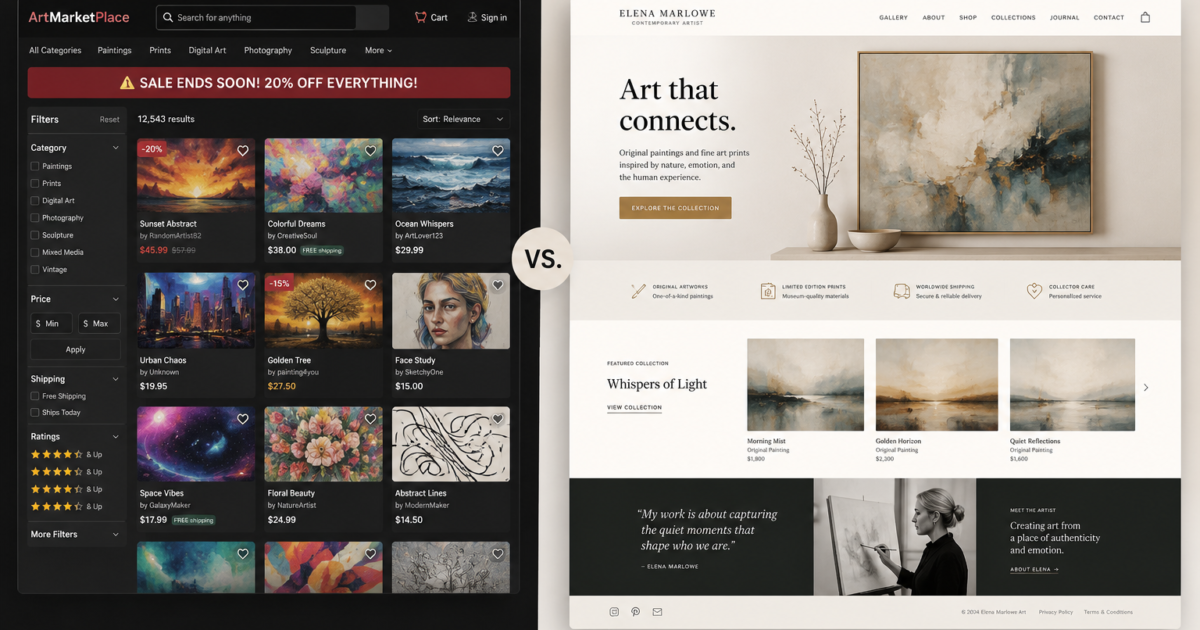
For artists, photographers, and creative entrepreneurs, few decisions shape your business as much as where you choose to build your online presence. Your website is not simply a digital portfolio. It is your storefront, your brand headquarters, your marketing engine, and your sales funnel all at once. Get the foundation right and everything else becomes easier; get it wrong and you spend years fighting against limitations you cannot see until they are holding you back.Most artists begin somewhere familiar. They open an Etsy shop, list a few pieces on Fine Art America, or upload work to Saatchi Art, because those platforms are easy to start with and already have visitors. There is nothing wrong with that as a first step. But many creators eventually discover that the very things that make marketplaces easy to join are the same things that cap their growth. The question of finding the best website platform for artists is really a question about ownership, branding, and whether you are building an asset of your own or renting space inside someone else’s.In this guide we will compare the realistic options available to working artists, look honestly at what each one does well and badly, and explain why a dedicated, professionally built website tends to produce stronger branding, better search visibility, and higher conversions over the long run.
The three main options for selling art online
Broadly, artists choose between three types of home for their work, and understanding the trade-offs of each is the first step toward picking the best website platform for artists in your specific situation.
Online marketplaces
Platforms like Etsy, Saatchi Art, Fine Art America, and Society6 are the most common entry point, and for good reason. Setup takes minutes, listing a product is straightforward, the technical barrier is almost nonexistent, and you gain immediate access to an audience of people who are already there to shop. For an artist making a first sale, that built-in traffic feels like magic.The drawbacks reveal themselves over time. Commission fees and listing charges take a meaningful bite out of every sale, and they never stop. Competition is fierce, because the same audience that finds you can find a thousand other artists on the same page, often undercutting each other on price. Your branding is constrained by the marketplace’s template, so your shop looks broadly like every other shop. Perhaps most importantly, you usually do not own your customer data, which means you cannot build a direct relationship with the collectors who buy from you. And because you are subject to the platform’s rules and algorithm, a single policy change or ranking tweak can cut your visibility overnight through no fault of your own. Marketplaces can deliver early exposure, but relying on them alone means you are spending your energy building someone else’s brand rather than your own.
Generic website builders
The next step many artists take is a general-purpose builder such as Squarespace, Wix, Shopify, or a self-hosted WordPress site. This is a genuine improvement in one crucial respect: you own the space. You control your branding, you keep your customer list, you can add a blog, and you have real ecommerce functionality if you set it up.The catch is that these tools are built for everyone, which means they are optimized for no one in particular. Out of the box, none of them understand the specific needs of selling art, things like presenting large high-resolution images without slowing the page to a crawl, managing limited editions, or handling print-on-demand fulfillment. The generic templates rarely showcase visual work at the level art deserves, and achieving strong search performance often requires customization and technical knowledge that most artists would rather not spend months acquiring. A general builder can absolutely work, but many artists find themselves doing a great deal of manual configuration to make a tool designed for selling t-shirts or consulting services suit the way art actually sells.
Artist-specific professional platforms
The third option is a platform purpose-built for creative businesses. Instead of bending a generic tool to fit, you start with a system that already assumes you are selling visual work to collectors. That means high-end visual presentation, portfolios optimized to convert browsers into buyers, ecommerce tools designed around originals and prints, print-on-demand functionality, search optimization handled as part of the build rather than as an afterthought, and brand-building strategy baked in. The result is a premium digital experience designed from the ground up to turn visitors into collectors, which is exactly what most artists are trying to achieve and exactly what the other two options leave you to engineer yourself.
The features every serious art website needs
Whichever direction you lean, there are non-negotiables. Knowing them helps you evaluate any platform honestly rather than being dazzled by a slick sign-up flow.Visual presentation comes first. Art is inherently visual, and the quality of your presentation directly shapes how much value a buyer assigns to your work. That means large, crisp image displays, clean uncluttered galleries, a layout that looks just as good on a phone as on a desktop, and fast load speeds so a beautiful image is never trapped behind a slow page. A premium aesthetic is not vanity here; it is part of what convinces a collector that your work is worth what you are asking.Real ecommerce capability matters next. A contact form is not a store. Selling art properly calls for secure checkout, support for product variants, the ability to manage limited editions, shipping calculators that handle the realities of mailing physical work, print options, discount codes, and natural opportunities to upsell. If you sell reproductions, the mechanics of pricing and fulfilling them well deserve real attention, and our guide on how to price and sell art prints online walks through that side of the business in depth.Search architecture turns a beautiful site into a discoverable one. A website can be stunning and still be invisible if search engines cannot understand it. The fundamentals include control over your metadata, optimized product pages, blog support, descriptive alt text on every image, structured schema markup, and solid technical performance. Google’s own SEO Starter Guide is a sound place to understand the basics, and we go deeper into the art-specific side in our article on SEO for artist websites.Marketing integrations tie it all together. Your website should connect to email marketing, capture leads through well-placed forms, feed analytics so you can see what is working, integrate with the social channels where your audience already spends time, and support ongoing content marketing. Social platforms in particular are powerful for filling the top of your funnel, and there is a real craft to converting followers into buyers, which we cover in our guide to social media marketing for artists.
Why a professional website outperforms a marketplace
The deepest reason to favor owning your website comes down to a simple equation: website ownership is business ownership. When the site is yours, so is your customer list, your accumulated search equity, your branding, your traffic channels, and your long-term growth strategy. You are building a durable asset that compounds in value, rather than borrowing visibility that can be revoked. Five years of effort poured into your own domain still belongs to you; five years poured into a marketplace profile belongs largely to the marketplace.Brand authority follows from ownership. Collectors are simply more inclined to trust an artist with a professional, self-hosted presence than one who exists only as a marketplace listing among thousands. A polished website signals seriousness, quality, and premium value, and that perception gives buyers the confidence to spend more. The same painting can feel like a casual hobby sale on a crowded marketplace and a considered acquisition on a well-built artist site.Conversion rates tend to reflect this too. Professional websites usually convert better than marketplaces because they remove distractions, focus a visitor’s attention on your work rather than on competing listings, build trust through design and storytelling, and let you guide buyers through a deliberate sales funnel instead of leaving them to wander. The cumulative effect is a higher percentage of visitors who become collectors.
Common mistakes artists make when choosing a platform
A handful of avoidable errors trip up creators again and again. The most frequent is choosing on price alone, treating the cheapest option as the smartest when the real measure is long-term return. Close behind is ignoring search optimization entirely, which leaves a lovely site that no one ever finds. Many artists also settle for poor-quality templates that flatten the impact of their work, overlook how their site behaves on mobile despite most browsing happening on phones, and lean so heavily on social media that they never build a home base they actually control. Failing to collect emails is another quiet mistake, because an email list is one of the few audiences a platform change can never take away from you. Recognizing these patterns is half the battle; the best website platform for artists is the one that helps you sidestep them by default rather than leaving each as a task on your to-do list.
The long-term business advantage
Artists who invest in a professional website tend to gain compounding benefits over time: sustainable traffic that does not depend on a single algorithm, healthier profit margins once marketplace commissions are out of the picture, stronger collector retention through direct relationships, search equity that grows with every page you publish, the ability to scale without renegotiating with a platform, and genuine brand equity that increases the perceived value of everything you make. These are precisely the foundations that allow a creator to move from occasional hobbyist sales into a sustainable, full-time creative business. If you want to see what that foundation looks like in practice, you can request a free demo and walk through a setup built specifically for selling art.
Conclusion
Choosing where to build your art business is one of the most consequential decisions you will make as a creative entrepreneur. Marketplaces can be a reasonable starting point and a useful supplement, but they were never designed to give you ownership, branding control, search equity, or the conversion power that a dedicated website provides. The artists who build the most durable businesses are almost always the ones who eventually plant their flag on a site that is truly their own.Artpreme helps artists and photographers build professional, high-converting websites designed specifically for creative businesses, combining premium design, real ecommerce tools, and strategic marketing support. If you are weighing your options, our complete guide on how to sell art online successfully is a good next read, and when you are ready to see it firsthand you can request a free demo.
Frequently asked questions
What is the best website platform for artists?
The best platform is one that combines strong branding control, built-in search optimization, real ecommerce functionality, and art-specific design features tailored to selling creative work. For most serious artists that points toward a dedicated, professionally built website rather than a generic builder or a marketplace listing.
Is Etsy enough for professional artists?
Etsy can supplement your income and help you make early sales, but it caps your branding, charges ongoing fees, and keeps you dependent on its audience and rules. Serious artists benefit significantly from owning their own website alongside, or instead of, a marketplace presence.
Why do artists need a dedicated website?
A dedicated website gives you ownership of your customer relationships, full control over your branding, the ability to build lasting search equity, and stronger long-term profitability. It turns your online presence into an asset you own rather than space you rent.
We respect your privacy - your information is protected.
Thank you for your submission.
A representative will contact you shortly from a Wyoming phone number (307 area code).