
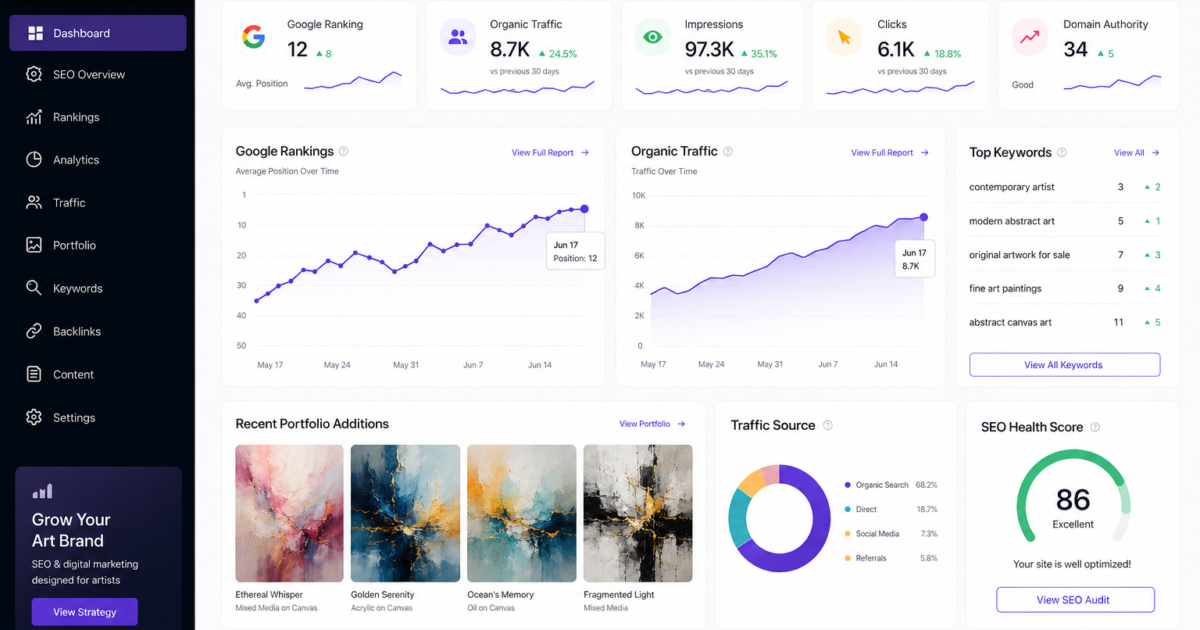

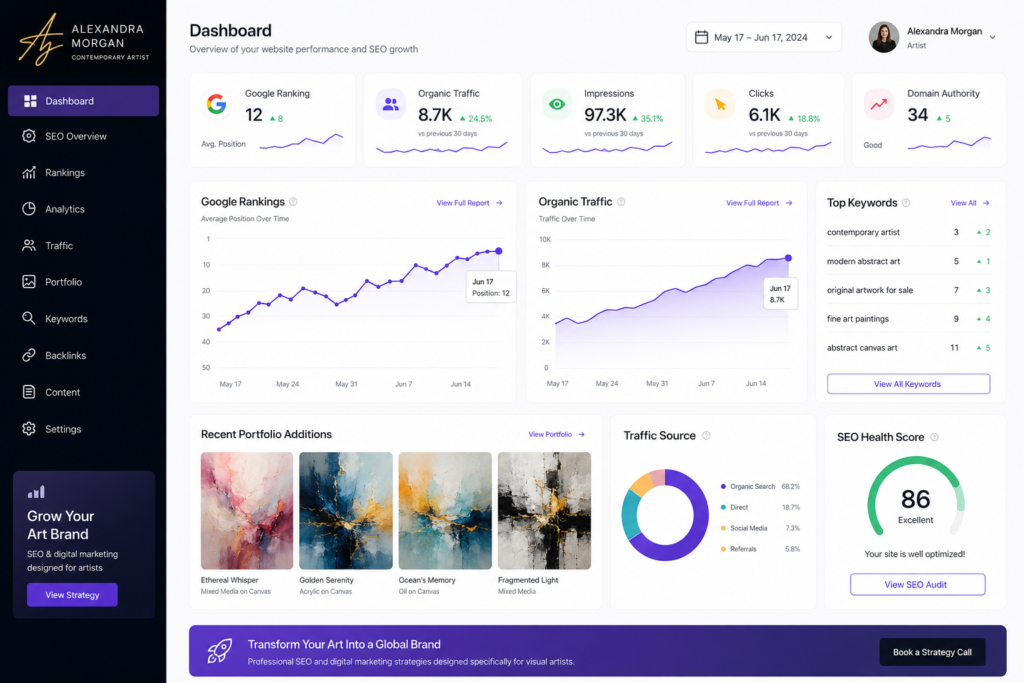
Most artists and photographers pour significant effort into making their websites look beautiful and then wonder why nobody finds them. The answer, almost always, is that the site was built for human eyes but not for search engines. A stunning portfolio that Google cannot understand or surface in results is invisible to the vast majority of potential buyers, because the reality of how people discover art online has changed: they search for it. Terms like “contemporary landscape photography,” “abstract wall art for living room,” or “buy original paintings online” are typed into Google thousands of times every day by people with genuine purchase intent, and the artists whose websites appear in those results get a steady stream of free, high-quality traffic without paying for ads or depending on social media algorithms.
Search engine optimization SEO is the practice of making your website visible in those results. For artists, it is one of the most underused and highest-returning growth channels available, because most creative competitors ignore it entirely. This guide explains how SEO for artist websites actually works, what to prioritize, and how to turn your site into something Google wants to recommend.
Why SEO matters more for artists and photographers than most creators realize
The fundamental advantage of search traffic over every other channel is intent. When someone finds your work through Instagram, they were scrolling and happened to stop that is passive discovery. When someone finds your work through Google, they typed a specific query because they are actively looking for what you sell, that is active demand. The difference in conversion rates between passive and active traffic is enormous, and it is why a website receiving two hundred visits a month from search often outperforms one receiving two thousand from social media.
The second advantage is durability. A social media post has a lifespan measured in hours. A well-optimized page on your website can rank in Google and bring in visitors for years with no ongoing effort beyond occasional updates. SEO compounds in a way that social media does not, every new page you optimize, every blog post you publish, every product listing you write well adds another entry point through which people can find you. Over time, this builds a body of discoverable content that works around the clock, which is exactly the kind of sustainable, passive traffic that lets an artist focus on creating rather than constantly marketing. If you are still weighing where to build your site, our comparison of the best website platforms for artists covers how different platforms handle SEO out of the box.
How search engines evaluate artist websites
Google’s job is to match a searcher’s query with the most relevant, trustworthy, and well-presented result it can find. It does this by crawling your website (reading every page), indexing it (storing and categorizing what it found), and ranking it against every other page that could answer the same query. For an artist’s website, that means Google needs to be able to understand what your site is about, what each page offers, how authoritative and trustworthy your domain is, and how good the user experience is when someone lands on it.
This is not mysterious or overly technical. It comes down to a handful of fundamentals executed consistently: making sure Google can read your content, telling it clearly what each page is about, earning trust through quality signals, and delivering a fast, mobile-friendly experience. Google’s own SEO Starter Guide is an excellent primer on these principles, and everything in this article builds on that foundation with art-specific guidance.
On-page SEO: the elements you control directly
Page titles and meta descriptions
Every page on your site has a title tag (what appears in the browser tab and in Google’s search results) and a meta description (the short summary below the title in results). These are your first and often only chance to convince someone to click. A title like “Untitled – My Art” tells Google and the searcher nothing. A title like “Abstract Landscape Paintings | Original Art by [Your Name]” communicates exactly what the page offers and includes terms people actually search for. Write every title and meta description deliberately they should be accurate, descriptive, and include your target keywords naturally.
Image alt text
Art websites are image-heavy by nature, and every image is an SEO opportunity that most artists miss entirely. Alt text is the written description attached to an image that tells search engines (and screen readers) what the image shows. An empty alt tag alt="" is a wasted signal. A descriptive one “original abstract oil painting in blue and gold, 36×48 inches on canvas” helps Google understand and index your visual content, and can surface your work in Google Image Search, which is a genuine traffic source for artists. Write alt text for every image on your site as if you were describing it to someone who cannot see it.
Product page optimization
If you sell work through your website, each product page is a potential landing page from search. That means each one needs a unique, descriptive title, a real written description (not just dimensions and price), alt text on every product image, and structured data (schema markup) that helps Google display rich results like price and availability. The artists who treat each product page as a piece of content not just a listing consistently rank better than those who post an image and a price with no context. For artists selling prints specifically, the product page is also where edition details, format options, and sizing information belong our guide on how to price and sell art prints online covers the product strategy side of this.
Technical SEO: the foundation beneath the content
Technical SEO refers to the behind-the-scenes elements that affect how Google crawls, renders, and evaluates your site. You do not need to become a developer to get these right, but you do need to make sure they are handled either by your platform, your theme, or someone who knows what they are doing.
Site speed is the most impactful technical factor for most artist websites. Image-heavy sites are naturally prone to slow loading, and Google uses page speed as a ranking signal. Compressing images, serving them in modern formats like WebP, using caching, and minimizing unnecessary scripts can make a dramatic difference. A site that loads in under two seconds creates a better user experience and a better impression on Google than one that takes five.
Mobile responsiveness is non-negotiable. Google uses mobile-first indexing, meaning it evaluates the mobile version of your site as the primary version. If your galleries, product pages, or checkout do not work well on a phone, your rankings will suffer regardless of how good the desktop experience is. Test your site on an actual phone, not just by resizing your browser window.
Clean URL structure helps both Google and visitors understand your site. URLs like /paintings/abstract-landscape-blue-gold are far more readable and rankable than /product?id=4827. Your platform should generate clean, descriptive URLs by default.
SSL (HTTPS) is a confirmed ranking factor and a basic trust signal. If your site still loads over HTTP, fix that before doing anything else.
Content strategy: blogging for search visibility
A blog is one of the most powerful SEO tools available to artists, and one of the most neglected. Each blog post is a new page that can rank for a different set of search terms, which means each one expands the number of queries through which people can discover you. The key is to write about topics your potential buyers are actually searching for not diary-style studio updates (which no one searches for), but informational content that intersects with your expertise and your audience’s interests.
For a landscape photographer, that might mean posts about the best locations for nature photography, how to choose wall art for a living room, or how to care for fine art prints. For an abstract painter, it could be posts about color theory in interior design, how to commission custom artwork, or the difference between giclée and lithograph prints. Each of these targets a real search query, positions you as an authority, and creates a natural path from “helpful article” to “this artist sells exactly what I am looking for.” The blog content also creates internal linking opportunities connecting your informational posts to your product pages and vice versa which strengthens your entire site’s SEO architecture.
Keywords: finding the right terms to target
Keyword research does not need to be complicated for artists. The goal is to find the terms your ideal buyers are actually typing into Google and then make sure your pages are optimized for those terms. Start with the obvious: what do you sell, and how would someone search for it? “Buy abstract paintings online,” “landscape photography prints,” “commission portrait artist” these are the kinds of commercial-intent terms your product pages should target.
Then think about informational intent the questions people ask before they are ready to buy. “How to choose art for a living room,” “what size print for above a sofa,” “how to hang a gallery wall” these are the queries your blog posts can capture. Free tools like Google’s own autocomplete (start typing a query and see what it suggests) and the “People also ask” boxes in search results are surprisingly effective for discovering what your audience wants to know. You do not need expensive SEO software to get started; you need to think like your buyer and write accordingly.
Common SEO mistakes artists make
The same errors appear across nearly every artist website that struggles with search visibility. Poor or missing metadata means Google has to guess what your pages are about rather than being told directly. Slow-loading sites usually caused by unoptimized images drive visitors away and signal low quality to search engines. Having no blog strategy means you are limited to ranking for a handful of product-related terms instead of casting a wide net. Ignoring keyword intent leads to pages optimized for terms nobody searches for, or terms that attract the wrong audience. And weak internal linking, the connections between your pages leaves Google unable to understand how your content relates to itself and prevents authority from flowing through your site. Each of these is fixable, and fixing them often produces visible ranking improvements within weeks. For the traffic you generate beyond search, our guide to social media marketing for artists covers how to build a funnel that complements your SEO efforts.
Conclusion
SEO is one of the highest-return investments an artist can make in their business. Unlike paid ads, which stop working the moment you stop paying, and social media, which resets with every algorithm change, search optimization builds an asset that compounds over time. The work is not glamorous writing alt text, crafting metadata, publishing blog posts, optimizing load speeds but the payoff is a website that attracts buyers on its own, every day, without requiring your constant attention.
For a broader view of how SEO fits into the full picture of building an art business online, our guide on how to sell art online successfully covers everything from website ownership to marketing strategy. And when you are ready to build on a foundation designed for search visibility from the ground up, Artpreme creates artist websites with SEO-focused architecture, premium design, and growth strategies built for creatives. Request a free demo to see how it works.
Frequently asked questions
How do artists improve their SEO?
Start with the fundamentals: write descriptive page titles and meta descriptions, add meaningful alt text to every image, optimize your product pages with real written content, make sure your site loads fast and works well on mobile you can also test the speed by using pagespeed.web.dev, and publish blog posts that target terms your potential buyers are searching for. Consistency matters more than perfection, steady improvements compound over time.
Is SEO important for photographers?
Absolutely. Photographers benefit from SEO in multiple ways: attracting local clients searching for portrait or event photography, reaching print buyers looking for wall art in specific styles, and building visibility with a global audience through image search. Photography is inherently visual, and Google Image Search is a significant traffic source when images are properly optimized with descriptive alt text and metadata.
How long does SEO take to produce results?
Most sites begin to see meaningful improvements within three to six months of consistent optimization work, though some changes (like fixing technical issues or adding metadata) can produce faster results. SEO is a long-term strategy that compounds and the results you build in month three make month six stronger, and the work you do in year one continues paying off in year two and beyond.
