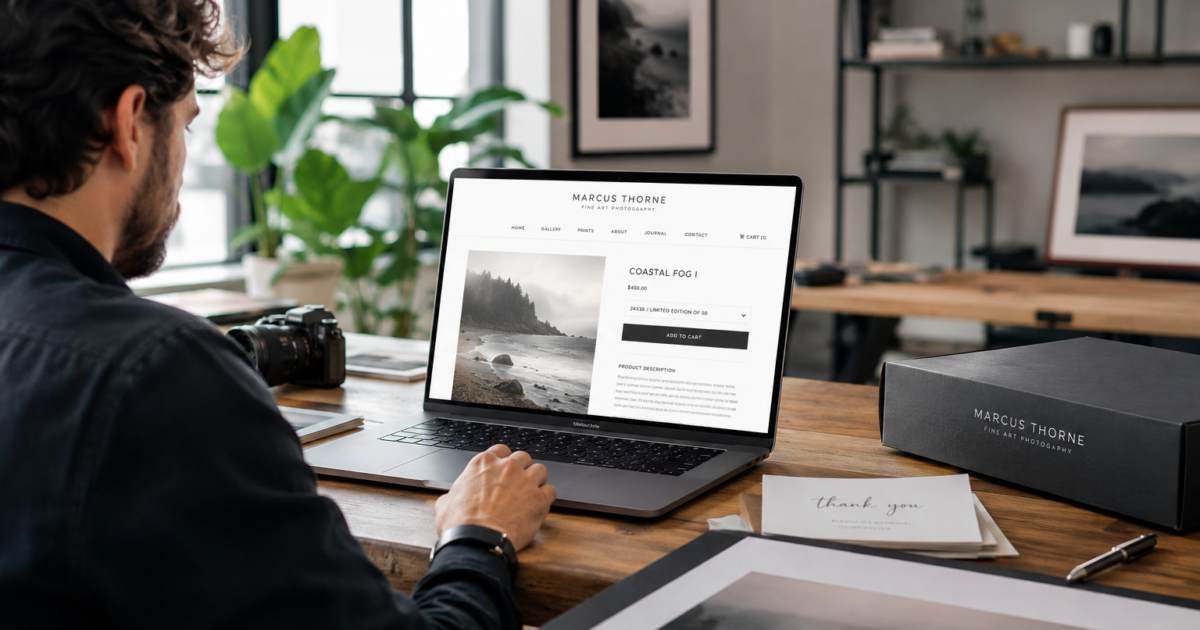
How to Sell Art Online Successfully: The Complete Guide for Artists and Photographers in 2026
Artpreme
9 min read
Selling art online has never offered more opportunity or more competition. Artists and photographers are no longer limited to galleries, local fairs, or word-of-mouth referrals. With the right digital strategy, a creative person working from a home studio can reach collectors on the other side of the world, set their own prices, and build a business that runs around the clock without a gallery taking half the revenue.But opportunity alone does not produce income. The artists who actually make a sustainable living online are not just talented they are deliberate. They treat their creative practice as a business, and they build the infrastructure to support it: a professional website they own, real ecommerce capability, search visibility, and marketing systems that bring the right people to the right work at the right time. This guide walks through how to sell art online in a way that lasts, covering the foundations that separate artists who thrive from those who plateau after a few early sales.
Why selling art online matters more than ever
The shift to online art buying was well underway before the pandemic accelerated it, and it has not reversed. Collectors increasingly discover and purchase art through the internet, and younger buyers in particular expect to browse, evaluate, and buy without ever visiting a physical space. For artists, this means a professional online presence is no longer optional it is the primary channel through which most sales will happen.Three advantages make the online model especially powerful for independent artists. First, geographic reach: a painter in a small town can sell to a collector in London or Tokyo without either of them traveling. Second, profit margins: selling directly through your own website eliminates the gallery commissions and marketplace fees that typically consume thirty to fifty percent of every sale. Third, ownership: when you control your website, you control your brand, your customer relationships, and your data none of which belong to you when you sell through someone else’s platform.
The best ways to sell art online
Build your own website
If there is one decision that separates artists who build durable businesses from those who stay dependent on external platforms, it is this: own your website. A dedicated site gives you full control over how your work is presented, how your brand is perceived, and how visitors move from browsing to buying. It lets you build an email list of people who have already expressed interest in your work an asset no algorithm change can take away. And it gives you the foundation for every other marketing effort, because every social post, every email, and every collaboration ultimately needs somewhere credible to send people. If you are weighing the options, our comparison of the best website platforms for artists breaks down how dedicated artist platforms differ from generic builders and marketplaces.
Diversify your revenue streams
Artists who rely on a single product type say, only original paintings cap their income at the number of originals they can physically produce. The most successful online art businesses layer multiple offerings: original works at premium prices, limited edition prints that create urgency and collectibility, open edition prints that reach buyers at lower price points, merchandise like apparel or home goods featuring your imagery, digital downloads for commercial or personal use, and commissions for collectors who want something made specifically for them. Each stream reaches a different buyer at a different budget, and together they create a business that is far more resilient than any single product line. Our guide on how to price and sell art prints online covers the print side of this in detail, including edition strategy and fulfillment.
Use tools designed for creative businesses
Selling art is not the same as selling electronics or clothing, and the tools you use should reflect that. At a minimum, your platform needs secure checkout that feels trustworthy, product presentation that does justice to visual work, print-on-demand functionality if you offer reproductions, mobile optimization so the growing share of phone-based buyers can browse and purchase without friction, and built-in search optimization so your pages have a chance of appearing in Google results. Generic ecommerce platforms can technically do most of these things, but they rarely do them well for art out of the box which is why artist-specific solutions exist.
Why marketplaces alone are not enough
Platforms like Etsy, Saatchi Art, Fine Art America, and Society6 serve a genuine purpose: they give artists immediate access to an existing audience of buyers, and they require almost no technical setup. For a first sale or early validation, that can be valuable. But marketplaces come with structural limitations that become more costly the longer you rely on them. You compete directly against thousands of other artists on the same page often with the platform’s own algorithm deciding who gets seen. Commission fees and listing charges eat into every transaction. Your branding is confined to whatever the marketplace’s template allows, which means your shop looks broadly like everyone else’s. And most critically, you typically do not own your customer data, so you cannot build a direct relationship with the people who buy from you. A marketplace sale is a transaction; a website sale is the beginning of a collector relationship. The artists who build lasting businesses almost always reach a point where they need their own home base, even if they keep a marketplace presence as a supplementary channel.
Essential marketing strategies for artists
Search engine optimization
SEO is the practice of making your website visible in Google and other search engines, and for artists it is one of the most underused growth channels available. When someone searches for “contemporary landscape photography” or “abstract oil paintings for sale,” the artists whose websites appear in those results get free, high-intent traffic people who are actively looking for what they sell. The fundamentals include optimizing your product pages with descriptive titles and thoughtful metadata, writing meaningful alt text for every image so search engines can understand visual content, publishing blog posts that address the questions your potential buyers are asking, and maintaining strong technical performance so your pages load quickly and work well on mobile. We cover the full approach in our guide to SEO for artist websites, and Google’s own SEO Starter Guide is a solid primer on the basics.
Social media marketing
Social platforms Instagram, TikTok, Facebook, Pinterest are where most artists already spend time, and they are genuinely powerful for building an audience and showing your creative process. The mistake is treating social media as your entire strategy rather than as one piece of a larger system. Social platforms are rented ground: their algorithms change, their reach fluctuates, and your follower count does not belong to you. The smart approach is to use social channels to attract attention and then funnel that attention back to your website, where you control the experience and can convert followers into email subscribers and buyers. Our article on social media marketing for artists goes deeper into how to make that funnel work.
Email marketing
Email remains one of the highest-converting marketing channels for art sales, and it is the one most artists neglect the longest. Unlike social media, your email list is yours no algorithm sits between you and your subscribers. A well-maintained list of collectors and fans who have opted in to hear from you gives you a direct line to the people most likely to buy, and it works especially well for launches, limited editions, and studio updates that build personal connection. The key is to start collecting emails from day one, even before you have much to send, because the list compounds over time and becomes one of your most valuable business assets.
Building a strong art brand
Branding is not just a logo or a color palette it is the overall impression your business makes, and for artists it is inseparable from the work itself. A strong brand tells a coherent story: who you are, what you create, why it matters, and who it is for. It shows up in the quality of your website design, the consistency of your visual presentation across platforms, the way you talk about your work, and the experience a buyer has from first click to unboxing. Artists who invest in premium positioning meaning their website, packaging, communication, and pricing all signal quality consistently command higher prices and attract more serious collectors. Branding is not vanity; it is the framework that makes everything else (marketing, SEO, sales) more effective.
Common mistakes artists make when selling online
Certain patterns show up repeatedly among artists who struggle to gain traction online. Relying entirely on social media without building a website means you have visibility but no foundation one algorithm shift and your reach evaporates. Using a generic website template that was not designed for visual work can flatten the impact of your art and make your business look interchangeable with thousands of others. Neglecting SEO leaves a beautiful site invisible to the people searching for exactly what you offer. Weak or inconsistent branding makes it harder for collectors to remember you, trust you, and return. And underpricing your work often out of insecurity or a desire for quick sales trains your audience to expect bargains and makes it very difficult to raise prices later. Each of these is avoidable, and the artists who recognize the patterns early save themselves years of stalled growth.
Why professional websites convert better
There is a measurable difference between how buyers behave on a professional artist website and how they behave on a marketplace listing or a generic template site. Professional websites build trust through design quality, reduce distractions by focusing the visitor’s attention on your work rather than on competing listings, enable strategic sales funnels that guide a browser toward a purchase, and create an experience that justifies premium pricing. The result is higher conversion rates, larger average order values, and crucially more repeat purchases, because a collector who has a premium experience is far more likely to come back. If you want to see what an artist-specific setup looks like in practice, you can request a free demo and walk through a site built for exactly this purpose.
Conclusion
Learning how to sell art online successfully is less about mastering any single tactic and more about building a system where each piece reinforces the others. A professional website gives you ownership and credibility. Diversified revenue streams protect you from depending on any one product. SEO brings in buyers who are actively searching for what you make. Social media and email marketing fill the funnel and build relationships over time. And strong branding ties it all together into something that feels cohesive, trustworthy, and worth collecting.None of this requires being a tech expert or a marketing professional it requires being deliberate about treating your art as a business, and choosing tools that are built for the way art actually sells. Artpreme helps artists and photographers build exactly that kind of foundation: professional websites, real ecommerce, and strategic marketing support designed specifically for creative businesses. When you are ready to take the next step, request a free demo and see how it works.
Frequently asked questions
How do I start selling art online?
Start by building a professional website you own, setting up real ecommerce with secure checkout and product options, optimizing your pages for search engines, and creating at least one marketing channel (email or social media) that drives traffic to your site. The combination of these foundations matters more than any single tactic.
Is Etsy enough for selling art professionally?
Etsy can help with early discovery and supplemental sales, but it limits your branding, charges ongoing fees, and keeps you dependent on its algorithm and audience. Most serious artists benefit from owning their own website alongside or eventually instead of a marketplace presence.
What kind of website is best for selling art?
The strongest option for most artists is a platform built specifically for creative businesses one that combines high-quality visual presentation, art-focused ecommerce tools, print-on-demand capability, and built-in SEO support, rather than a generic builder you have to customize yourself.
We respect your privacy - your information is protected.
Thank you for your submission.
A representative will contact you shortly from a Wyoming phone number (307 area code).