
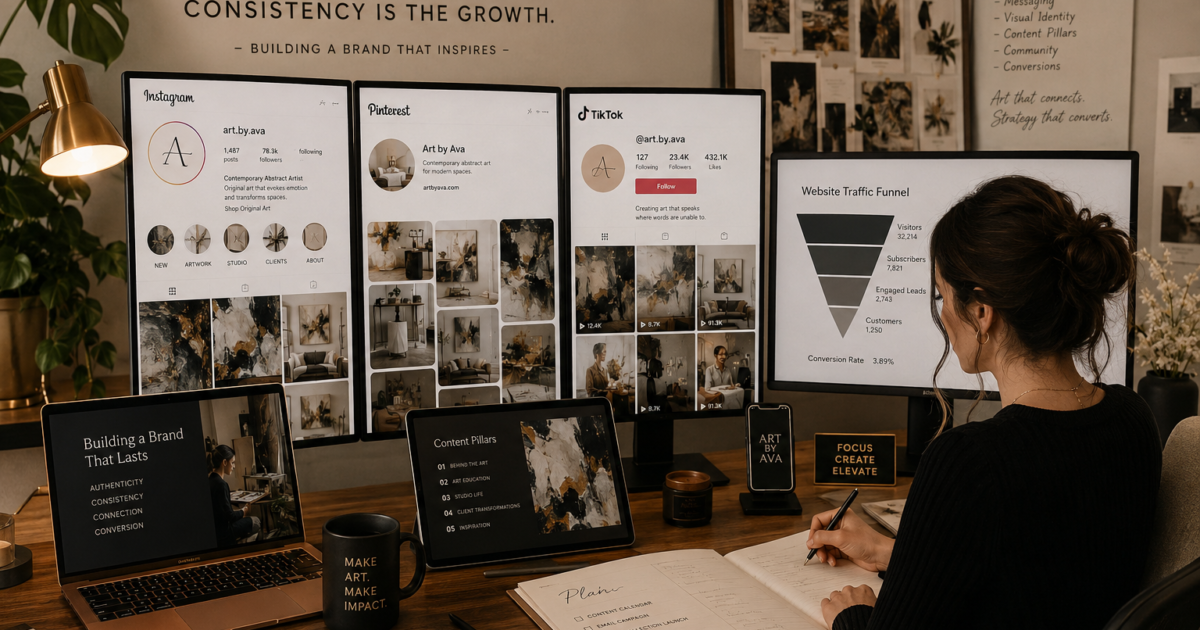

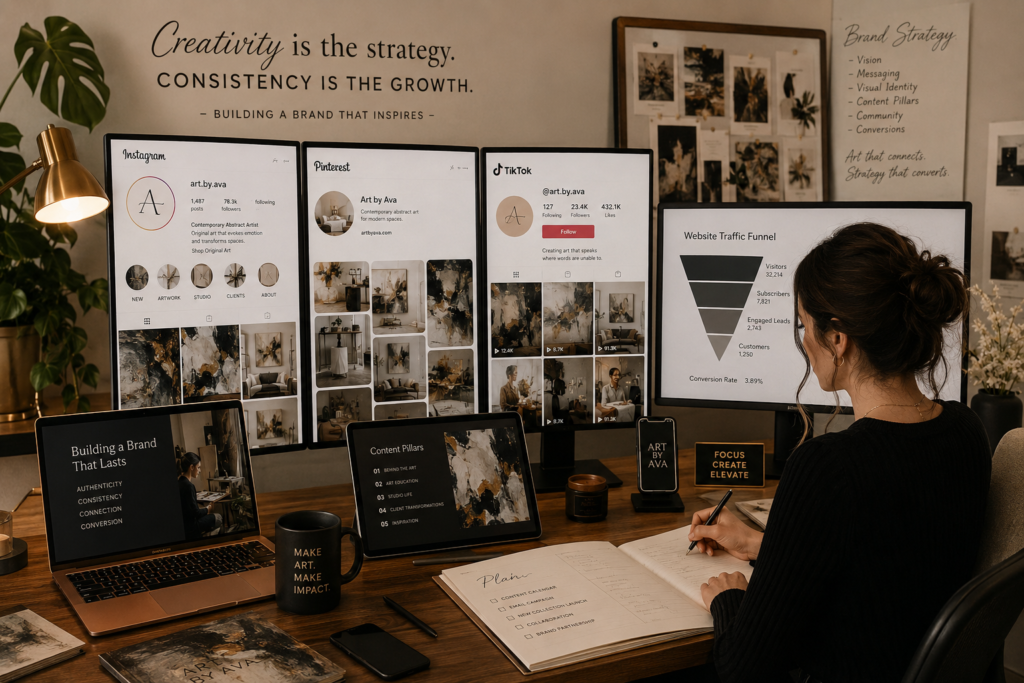
Social media is one of the most powerful visibility tools available to artists, photographers, and creative entrepreneurs. Platforms like Instagram, TikTok, and Facebook can put your work in front of thousands of people who would never find you otherwise, and they do it for free. For visual creators especially, the format is a natural fit your work is inherently engaging, shareable, and built for feeds.
But visibility is not the same thing as income, and this is where many artists get stuck. They build followings, collect likes, and spend hours creating content, then wonder why none of it translates into sales. The reason is almost always the same: they are using social media as a destination instead of as a bridge. Followers who stay on Instagram are Instagram’s audience, not yours. The artists who turn social media marketing into real business results are the ones who treat every platform as a traffic-generation engine that drives potential collectors to a website they own, where they control the branding, the experience, and the sale.
This guide explains how to build a social media strategy that actually moves the needle not just in likes and followers, but in website traffic, email subscribers, and paying customers.
Why social media matters for artists
The core advantage of social media is reach. A painter working from a home studio can put their work in front of collectors on the other side of the world, interior designers looking for pieces for client projects, photography buyers browsing for wall art, and niche communities built around specific styles or subjects. No other free channel offers that breadth of access, and for artists who are just starting to build an audience, social platforms are often the fastest way to get initial traction.
Visual platforms are especially well suited to creative work. Art stops the scroll in a way that most content cannot a striking image or a mesmerizing process video naturally commands attention. This gives artists a structural advantage on platforms that prioritize visual engagement, and it means that good creative work, presented well, can grow an audience without a large ad budget or a marketing team.
Beyond reach, social media builds something harder to quantify but equally important: brand familiarity. When someone sees your work repeatedly in their feed, they begin to recognize your style, associate it with a level of quality, and develop the kind of trust that eventually makes them comfortable buying. That brand-building effect compounds over time, and it works whether you have five hundred followers or fifty thousand.
The biggest mistake artists make on social media
The single most common and most costly mistake is treating social platforms as the entirety of your business rather than one piece of a larger system. When your entire presence lives on Instagram or TikTok, you are building on rented ground. Algorithm changes can cut your reach overnight and they do, regularly. Account restrictions or bans can erase years of work with no appeal. Organic reach on most platforms has been declining steadily for years. And critically, you do not own your follower list: you cannot email them, you cannot export them, and if the platform disappears or deprioritizes your content type, those followers are gone.
The solution is straightforward in concept even if it requires discipline in practice: use social platforms to attract attention, then funnel that attention back to your own website, where you control the experience, capture email addresses, and convert visitors into buyers. Your website is the asset you own; social media is the megaphone that points people toward it. Every post, every story, every reel should have a purpose that connects back to something you control. If you do not yet have a website that is built to receive and convert that traffic, our guide to the best website platforms for artists covers how to choose the right foundation.
The best social media platforms for artists
Instagram remains the strongest all-around platform for most visual artists. Its format is built for imagery, and features like Reels, Stories, and carousel posts give you multiple ways to show your work, your process, and your personality. Instagram is especially effective for building community, launching print collections, and sharing behind-the-scenes content that humanizes your brand. The limitation is that organic reach has tightened significantly, posting alone is no longer enough, and Reels currently receive far more distribution than static images.
TikTok offers the most explosive growth potential of any current platform. Short-form video of your creative process, painting, photographing, printing, packaging performs exceptionally well, and TikTok’s algorithm is more willing than Instagram’s to show your content to people who do not already follow you. The audience skews younger, which is worth considering for pricing and product strategy, but it also means you are reaching future collectors early. The trade-off is that TikTok traffic tends to be less purchase-ready than Instagram traffic, so the funnel back to your website matters even more here.
Facebook is often overlooked by artists but remains valuable for two specific things: paid advertising and community groups. Facebook’s ad platform (shared with Instagram through Meta) offers sophisticated targeting and retargeting tools that can be very effective for driving traffic to your website and re-engaging people who visited but did not buy. Facebook Groups built around art collecting, interior design, or specific creative niches can also generate meaningful engagement with an audience that skews older and often has more disposable income than TikTok’s user base.
Pinterest deserves a mention as a quiet workhorse. Unlike the others, Pinterest functions more like a visual search engine than a social network, people come to it with intent, searching for things like “abstract art for living room” or “landscape photography prints.” Pins have a much longer lifespan than posts on other platforms, and they drive website traffic directly because the entire platform is built around clicking through to external sites. For artists selling prints or home décor, Pinterest can be a steady source of high-intent visitors.
Content strategies that actually convert
Not all social content is created equal when it comes to driving business results. The posts that get the most likes are not always the posts that generate the most sales, and understanding the difference is key to using your time wisely.
Educational content builds authority and trust. Showing how your artwork is made, explaining your photography techniques, offering print care tips, or sharing interior styling inspiration positions you as knowledgeable and generous, qualities that make people more comfortable buying from you. Educational posts also tend to be saved and shared more than other content types, which extends your reach.
Storytelling content builds emotional connection. Collectors often buy stories as much as they buy art, the inspiration behind a piece, the personal journey that led to a body of work, the meaning of a particular collection. Sharing these narratives gives your audience a reason to care about your work beyond its visual appeal, and emotional connection is one of the strongest drivers of purchase decisions in art.
Promotional content drives action. New releases, limited edition drops, seasonal collections, and email signup invitations all have a place in your feed but they work best when they are surrounded by educational and storytelling content rather than making up the majority of your posts. A common guideline is roughly 70 percent value-adding content and 30 percent promotional, though the exact ratio matters less than the principle: give more than you ask.
Building the funnel from follower to collector
The concept of a sales funnel applies directly to how artists should think about social media. At the top of the funnel, social platforms create awareness, people discover your work, follow your account, and start engaging with your content. In the middle, you direct that engaged audience to your website through clear calls to action: “shop the full collection,” “explore new prints,” “join the collector email list.” At the bottom, your website and email list do the converting, product pages, checkout, follow-up emails, and collector nurturing that turns a one-time buyer into a repeat customer.
This structure transforms social engagement from a vanity metric into a repeatable revenue system. Every piece of content you create should serve one of these three levels: attract new people, move existing followers toward your website, or support the conversion and retention that happens off-platform. If you are also selling prints as part of your revenue mix, our guide on how to price and sell art prints online covers the product and pricing strategy that sits at the bottom of this funnel.
Paid advertising for artists
Organic social media is powerful but takes time to ramp up. Paid advertising particularly through Meta’s ad platform, which serves both Facebook and Instagram can accelerate results significantly when used strategically. The most effective approach for most artists is not broad prospecting ads but retargeting: showing ads specifically to people who have already visited your website but did not purchase. These visitors already know your work and have shown interest a well-timed reminder with a compelling image can be the nudge that converts them. Retargeting campaigns typically produce far better returns than cold-audience ads because the trust-building has already happened organically. Even a modest daily budget can produce meaningful results when it is focused on warm audiences.
Metrics that actually matter
One of the easiest traps in social media marketing is measuring the wrong things. Follower counts and like totals feel good but tell you very little about business health. The metrics worth tracking are the ones that connect to revenue: website clicks from social posts, email signups generated through social traffic, conversion rates on your product pages, actual sales attributed to social visitors, and if you run ads return on ad spend. These numbers tell you whether your social strategy is producing business results or just producing content. Check them monthly, and adjust your approach based on what you find rather than on how many hearts your last post collected.
Common social media mistakes artists make
A few patterns consistently hold artists back. Posting without a strategy, uploading work randomly with no connection to a broader goal wastes time and produces inconsistent results. Having no website funnel means your social effort has nowhere productive to send people. Inconsistent branding across platforms confuses potential collectors and weakens recognition. Weak or missing calls to action leave followers with no clear next step. Over-relying on a single platform means one algorithm change can devastate your visibility. And neglecting email marketing means you never build the owned audience that social media should be feeding. Each of these is fixable, and the artists who address them early see dramatically better returns from the same amount of creative effort. For the search visibility side of this equation, our guide to SEO for artist websites covers how to make sure the website you are sending social traffic to is also attracting visitors through Google.
Conclusion
Social media is a genuinely powerful growth tool for artists but only when it is used as part of a system rather than as the system itself. The artists who get the most from social platforms are the ones who pair strong content with a clear funnel back to a professional website, build an email list alongside their follower count, and measure success by business outcomes rather than vanity metrics. Social media attracts attention, your website converts it, your email list retains it. Get all three working together and social media stops being a time sink and starts being a revenue engine.
If social media is one piece of the puzzle, our complete guide on how to sell art online successfully covers the full picture, from website ownership and SEO to pricing and brand building. And when you are ready to put the infrastructure in place, Artpreme helps artists and photographers build professional websites designed to receive social traffic and turn followers into collectors. Request a free demo and see how it works.
Frequently asked questions
Which social media platform is best for artists?
Instagram is the strongest all-around choice for most visual artists thanks to its image-first format and community features. TikTok offers the fastest growth potential through short-form video. Pinterest is underrated for driving high-intent website traffic. The best strategy usually involves two or three platforms rather than trying to be everywhere.
Can artists sell directly through social media?
You can, and platform shopping features make it increasingly easy. But directing traffic to your own website typically produces better long-term results because you control the branding, own the customer data, build SEO equity, and avoid platform fees. It’s also more safe selling through website than dealing with sometimes unknown people online. Social selling works best as a supplement to website sales, not a replacement.
How often should artists post on social media?
Consistency matters more than volume. Three to five strategic posts per week is a sustainable pace for most solo artists and typically outperforms daily posting with no clear purpose. Focus on quality and intention, every post should either attract new followers, deepen engagement, or direct people to your website.
