

Prints are one of the most scalable revenue streams available to artists and photographers and for many creatives, they become the financial backbone of the entire business. A painter can only sell an original once, and a photographer’s digital files have no physical value to a collector on their own. Prints bridge that gap. They turn a single image into a product that can be sold hundreds of times over, reach buyers at a range of price points, and generate recurring income without requiring you to produce new work for every sale. Whether you are a fine artist looking to extend the life of your paintings or a photographer turning your best shots into wall-worthy pieces, a well-run print business can transform what you earn from your creative practice.
But “done well” is the operative phrase. Uploading a few images to a print on demand marketplace and hoping for the best is not a print strategy it is a lottery ticket. Artists who build genuinely profitable print businesses think carefully about pricing, edition structure, presentation, fulfillment, and how prints fit into their broader brand. This guide walks through how to sell art prints online in a way that produces real, repeatable income.
Understanding the two main print models
Before setting prices or choosing formats, you need to decide what kind of print business you are building, because the two primary models serve different purposes and attract different buyers.
Open edition prints
An open edition has no limit on the number of copies produced. The print remains available indefinitely, or until you choose to retire it. This model works best for reaching a broad audience at accessible price points, buyers who love your work and want something for their wall, but are not motivated by collectibility or scarcity. Open editions are highly scalable because there is no cap on sales, and they pair naturally with print-on-demand fulfillment since you do not need to manage inventory. The trade-off is that open editions generally command lower prices, because the buyer knows the print is not exclusive.
Limited edition prints
A limited edition restricts the total number of copies to a fixed run say, 10 or 20 and each print is typically numbered and signed. This model targets collectors who value scarcity and exclusivity, and it supports significantly higher pricing because the buyer is acquiring something that will not be available forever. Limited editions create natural urgency (once they sell out, they are gone), and they position your work as collectible rather than decorative. The trade-off is that your revenue per image is capped by the edition size, and managing editions requires more attention to inventory and numbering. Many artists offer both models: open editions for accessibility and volume, limited editions for premium positioning and collector relationships.
Pricing art prints strategically
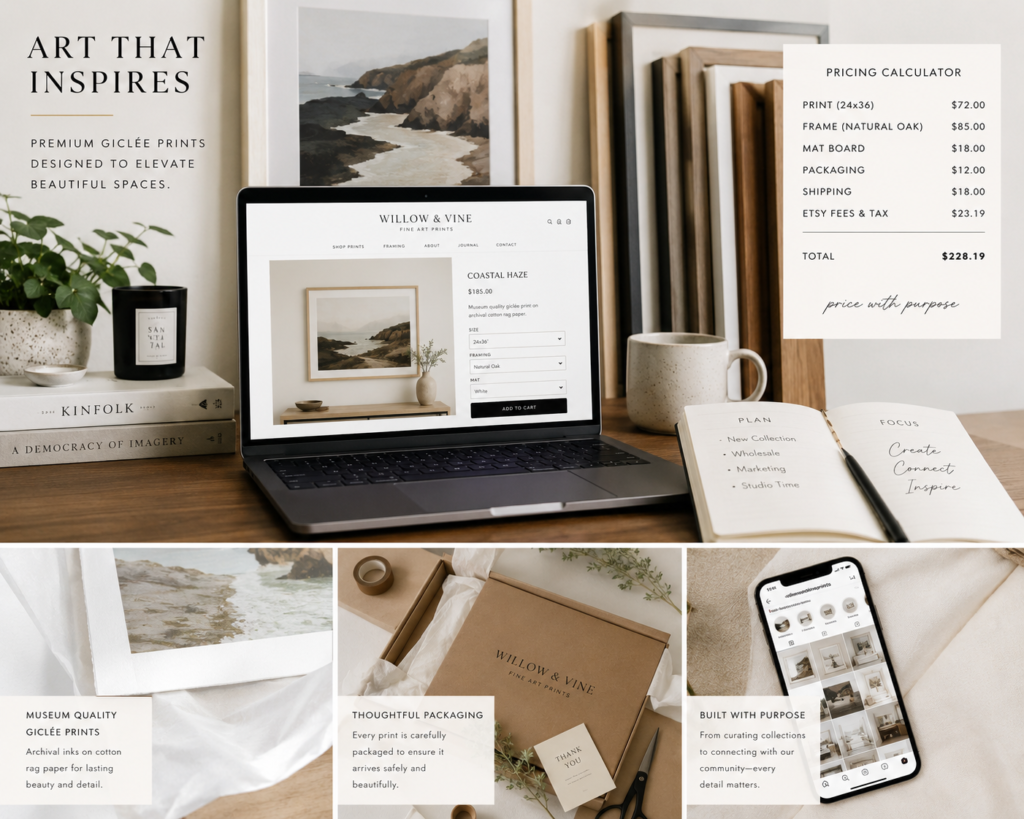
Pricing is where most artists either leave money on the table or price themselves out of sales entirely, and in both cases the mistake usually comes from not thinking through the full picture. The right price for a print is not a guess it is a calculation that accounts for several concrete factors: production cost (printing, materials, and any hand-finishing), packaging and shipping, the positioning of your brand, the demand for that particular image, and the exclusivity of the edition.
A widely used starting framework for premium giclée prints is to mark up your total production and fulfillment cost by roughly 200 to 400 percent. For example, if a giclée print costs $50 to produce, package, and ship, pricing it between $150 and $250 maintains healthy margins while positioning the work as premium rather than commodity. Open editions at the lower end of the market may use smaller markups, while limited editions or pieces from artists with strong brand recognition can often justify prices well above the 400 percent mark, because scarcity and perceived collector value do much of the selling.
The mistake to avoid above all others is underpricing. It is tempting to set low prices in hopes of generating volume, but cheap prints send a signal about the value of your work that is very difficult to reverse. Collectors associate price with quality, and a print listed at $30 tells a different story than one listed at $200 even if the image and the print quality are identical. Premium presentation, strong branding, and confident pricing work together: each one reinforces the others, and weakening any one of them undermines the rest. If you are building your broader sales strategy alongside your print business, our complete guide on how to sell art online successfully covers the full picture of pricing, positioning, and revenue diversification.
Choosing print formats
The format you offer shapes both the buying experience and the perceived value of the work. Paper prints (fine art giclée on archival paper) are the most traditional and widely expected option, and they work well for photography and illustration alike. Canvas prints feel more like finished pieces and often command higher prices because buyers perceive them as closer to an original, they arrive ready to hang without needing a frame. Metal prints offer a modern, high-contrast look that suits photography especially well, while acrylic prints provide a glossy, luminous quality that makes colors pop. Offering multiple formats gives buyers a reason to choose based on their space and taste rather than settling for a single option, and it increases your average order value because premium substrates naturally cost more. You do not need to launch with every format, starting with paper and canvas covers the majority of buyer preferences, and you can expand later based on what sells.
Building a website that sells prints effectively
Your print sales are only as strong as the platform they sit on, and the gap between a professional setup and a mediocre one shows up directly in your conversion rate. At minimum, your website needs high-quality product photography that shows prints as they actually look (ideally including lifestyle shots of prints in real rooms), clean galleries that let the work speak without visual clutter, multiple size and format options with clear pricing, secure checkout that feels trustworthy, mobile optimization so phone-based browsers can buy without friction, and natural opportunities to upsell, for example suggesting a larger size or a canvas upgrade during checkout.
Search optimization matters just as much for print pages as it does for your broader site. Every print listing should have a descriptive title, thoughtful metadata, and meaningful alt text on images, because these are the signals that help Google understand and surface your work. If someone searches for “landscape photography prints” or “abstract art for living room,” the artists whose product pages are properly optimized are the ones who appear. Our guide to SEO for artist websites covers the technical side in depth. And if you are still deciding what kind of site to build your print business on, our comparison of the best website platforms for artists breaks down how dedicated artist platforms differ from generic builders and marketplaces.
Marketing strategies for print sales
Search engine optimization
SEO is especially powerful for print sales because the people searching for terms like “buy wall art online,” “affordable abstract art prints,” or “nature photography for office” have purchase intent built right into the query. They are not casually browsing but they are looking to buy. Ranking for these terms means free, recurring traffic from people who are already in a buying mindset, which is far more valuable per visitor than social media traffic. The work involved is unglamorous, optimizing product page titles, writing real descriptions instead of one-liners, adding alt text to every image, and publishing supporting blog content but it compounds over time in a way that paid ads never do.
Social media funnels
Instagram, TikTok, and Pinterest are natural channels for selling prints because the work is inherently visual. The key is to use social platforms as the top of a funnel rather than as the entire sales process: attract attention with your imagery and creative process, then direct interested followers to your website where you control the experience and can convert them into buyers and email subscribers. A post that gets thousands of likes but sends no one to your store is entertainment, not marketing. Our guide on social media marketing for artists walks through how to build that bridge from follower to collector.
Email campaigns
Email is the most underrated sales channel for print businesses. New collection launches, limited edition drops, seasonal promotions, and behind-the-scenes studio updates all perform exceptionally well over email because the people on your list have already opted in to hear from you. Unlike social media, there is no algorithm between you and your audience, every message lands directly in their inbox. For limited editions in particular, email creates the urgency and exclusivity that drives fast sell-outs, because subscribers feel like insiders getting early access.
Brand building for your print business
The difference between an artist who sells prints at $40 and one who sells the same quality at $200 is almost always branding. Strong branding encompasses everything the buyer experiences: the professionalism of your website, the consistency of your visual identity across platforms, the story you tell about your work and your process, and the quality of the physical product when it arrives, packaging, print quality and any personal touches like a thank you note or a certificate of authenticity. Every one of these touchpoints either reinforces or undermines the price you are asking. Artists who treat branding as a serious investment rather than an afterthought consistently command higher prices and attract collectors who come back.
Common mistakes in print sales
A few recurring errors hold artists back more than anything else. Poor print quality is the most damaging, because a buyer who receives a disappointing print will hardly return and may share that experience publicly, how you handle that also matters. Weak or generic product descriptions miss the opportunity to connect emotionally with a buyer and give search engines nothing to work with. Ignoring SEO entirely means your prints are invisible to the people actively searching to buy them. Using a generic website template that was not designed for visual work flattens the impact of your art and makes your store look interchangeable with thousands of others. And over-relying on third-party platforms like Etsy or Society6 means building someone else’s brand while paying ongoing fees and competing against every other artist on the same page. Each of these is fixable, and fixing them is often the difference between a print business that stalls and one that grows.
Conclusion
Selling art prints online can become one of the most reliable and scalable revenue streams in your creative business but only when it is built on a foundation of strategic pricing, professional presentation, and real marketing. The artists who profit most from prints are the ones who treat them as a serious product line rather than an afterthought, and who invest in the infrastructure to present and sell them properly.
Artpreme helps artists and photographers build premium print-selling websites that maximize profitability, strengthen branding, and drive sustainable sales growth. If you want to see what a purpose-built print sales setup looks like, request a free demo and walk through it firsthand.
Frequently asked questions
Are art prints profitable?
Yes, prints are one of the most scalable income sources for artists and photographers because production costs are relatively low, the same image can be sold repeatedly, and you can reach buyers at price points that originals cannot. Profitability depends on pricing strategically, maintaining quality, and selling through your own platform rather than giving up large commissions to marketplaces.
How should artists price their prints?
A common framework is to mark up total production and fulfillment costs by 200 to 400 percent. A print that costs $50 to produce and ship might sell for $150 to $250. Limited editions and artists with strong brands can price significantly higher. The most important principle is to avoid underpricing, which signals low value and is very difficult to reverse.
What platform is best for selling art prints?
The strongest long-term option is a professional website with built-in ecommerce, SEO tools, and print-on-demand functionality, ideally one designed specifically for artists or photographers. Marketplaces can supplement sales, but owning your platform gives you full control over branding, pricing, customer relationships, and profit margins.
